
Reviewed · SKYDIVING & BUNGY
Skydive Auckland
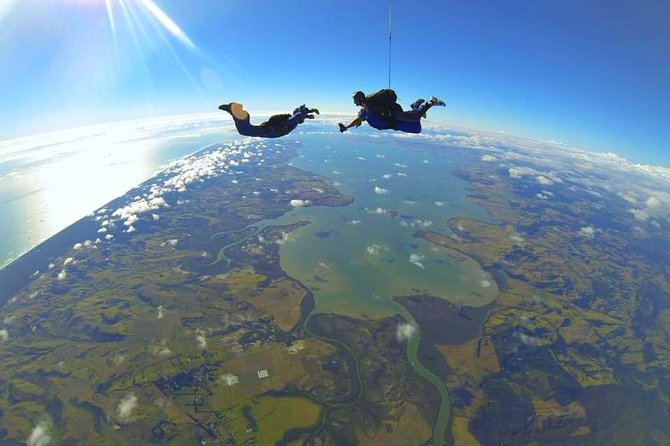
The big draw is simple: Skydive Auckland offers New Zealand’s highest advertised tandem jump, with options reaching 20,000 feet. At the top height, you can freefall for more than a minute at speeds above 200 km/h before your instructor opens the parachute. From Parakai, you may see Waiheke Island, Great Barrier Island, Piha Beach, both coasts, and distant volcanic peaks.
I like the wide coastal views, which give this more visual interest than a jump over a single patch of countryside. I also like the choice of heights, so you can weigh extra cost and freefall time against your own nerve level. The main consideration is weather: conditions can change quickly, and you need to call about an hour before your booking.
Key points before you book
- Choose your altitude carefully: Options are listed at 9,000, 13,000, 18,000, and up to 20,000 feet, with the highest option offering more than a minute of freefall.
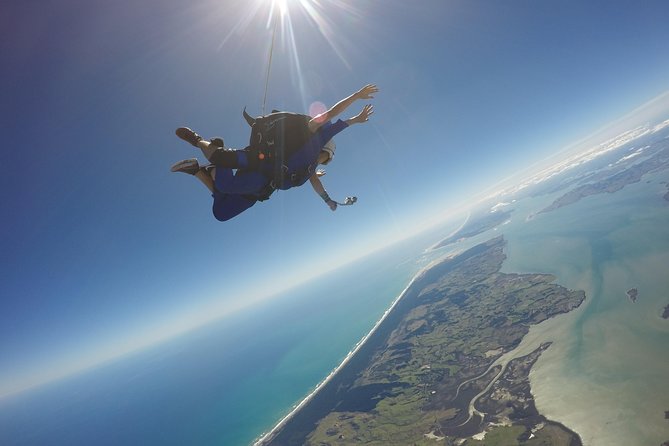
- Look in every direction: The flight can reveal Waiheke Island, Great Barrier Island, Piha Beach, both east and west coasts, Mount Ruapehu, and even Mount Taranaki.
- Expect a half-day commitment: The activity takes about three hours, plus the roughly 45-minute drive each way from central Auckland.
- Fly with your group: The turbine aircraft has 17 seats, making it possible to share the experience with friends, though the whole activity can include up to 100 people.
- Budget for photos and video: Equipment, the safety briefing, and the tandem jump are included. Photo and video packages cost extra.
- Check the rules first: The weight limit is 100 kilograms, and 18,000-foot jumps are limited to people aged 12 and over.
Why the Parakai setting makes this more than a quick thrill
Skydive Auckland operates from West Auckland Airport in Parakai, about 45 minutes from Auckland city by road. That location matters. You are not simply stepping from a plane over a small, anonymous patch of land. The views can stretch across beaches, islands, forest, and distant mountains.
From above, the east and west coasts give the flight a broad sense of place. On a clear day, you may spot Waiheke Island and Great Barrier Island, with Piha Beach and other coastal areas adding texture below. The information provided also lists Mount Ruapehu and Mount Taranaki among possible sights. Those distant peaks depend heavily on visibility, so treat them as a bonus rather than a promise.
The setting also gives friends something to share before and after the jump. The plane carries 17 people, and the company markets it as a way to jump with your group. That does not mean everyone will leave the aircraft at the same time, but it does make the experience feel more social than a private appointment with no one else around.
You meet at West Auckland Airport, Parakai, at 76 Green Road, Helensville. The activity finishes back at the same place. Round-trip hotel transport to the launch point is available, but you should confirm the transport arrangement when booking rather than assume it is included in the listed price.
Other ways to jump near Auckland:
- NZONE Skydive Queenstown
★ 4.5 · 1,438 reviews - Queenstown: Tandem Skydive Experience
★ 4.8 · 475 reviews - Lake Taupo 12,000-Foot Tandem Skydiving
★ 5.0 · 359 reviews
From arrival to the aircraft
Allow about three hours for the full activity. That time covers preparation, the safety briefing, the aircraft trip, the jump, and the return to the meeting point. The three-hour estimate is useful when planning a morning or afternoon in Auckland, but I would avoid scheduling a tight follow-up activity.
Your first important task is listening closely to the safety briefing. The company provides all equipment, so you only need comfortable clothing and secure shoes such as trainers or sneakers. This is not the day for loose sandals or footwear that could slip off.
The tandem format keeps the technical work with the instructor. You are attached to a trained professional, who handles the parachute system and guides you through the required body position and landing process. Your job is to listen, follow instructions, and keep your attention on the experience rather than trying to manage equipment yourself.
The company has more than 20 years in the industry and is affiliated with the NZPIA. It is also Qualmark approved and has received a TripAdvisor Certificate of Excellence. Those credentials do not remove the need to pay attention during the briefing, but they are useful signals for someone comparing operators.
An instructor named Owen is specifically mentioned in the supplied customer feedback. You can ask about him when you arrive, but do not book on the assumption that a particular instructor will be assigned to you.
Picking 9,000, 13,000, 18,000, or 20,000 feet
The altitude choice is the key decision. The lower 9,000-foot option may suit you if you want the tandem experience without paying for the longest possible freefall. The 13,000-foot package gives you more time in the air and a greater sense of scale.
The higher options are aimed at people who want the full high-altitude version. The operational description identifies an 18,000-foot jump with a 75-second freefall at more than 200 km/h. Elsewhere, the highest available option is described as 20,000 feet, or 6,096 meters, with more than a minute of freefall.
Because those descriptions differ, confirm the exact altitude available on your date and the price for each height. Do not assume that the advertised price of $214.10 applies equally to every package. The listed price gives you a useful starting point, but the altitude choice and any media package may change your final cost.
At 18,000 feet, the company says you must be at least 12 years old. Anyone under 18 needs a parent or guardian present. A 100-kilogram weight restriction applies, so check this before you reserve.
I like having several heights to choose from, since people arrive with very different comfort levels. Still, the higher jump is not automatically the better choice for everyone. The extra seconds of freefall can feel valuable, but they also mean a longer wait and a more intense sensation. If your main aim is to see Auckland from above, a lower option may provide the right balance.
What the 75-second freefall feels like on paper
The high-altitude option gives you a long period between leaving the aircraft and opening the parachute. Seventy-five seconds may not sound long in ordinary life, but it is a substantial amount of time when you are moving at more than 200 km/h.
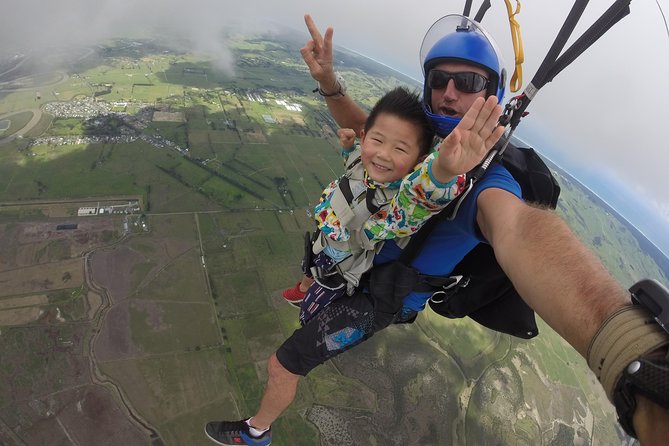
The first part is about sensation: wind, speed, and the need to keep your body position as instructed. Then the pace changes once the parachute opens. You get more time to look around and take in the views toward the islands, beaches, and mountain peaks.
The company’s customer feedback repeatedly points to the views, the friendly staff, and the feeling that this became a trip highlight. One person who had never tried a tandem jump before praised the guidance and the scenery. That matters because first-time nerves are likely to be the biggest obstacle for many people, not the physical difficulty.
Do not expect a quiet sightseeing flight. The aircraft ride and freefall are built around a strong physical rush. If you mainly want slow aerial views, Auckland has gentler ways to see the region. If you want the views tied to a major personal challenge, this is where the experience earns its price.
Same base, a different kind of day:
- Waiheke Island: Ferry & Hop-On Hop-Off Explorer Bus Tickets
★ 4.6 · 3,311 reviews - Hobbiton & Waitomo Caves Guided Day Trip from Auckland incl lunch
★ 5.0 · 2,677 reviews - From Auckland: Hobbiton & Waitomo Caves Day Trip with Lunch
★ 4.9 · 2,505 reviews - Auckland Dolphin and Whale Watching Eco-Safari Cruise
★ 4.5 · 1,790 reviews
The views: islands, beaches, and distant peaks
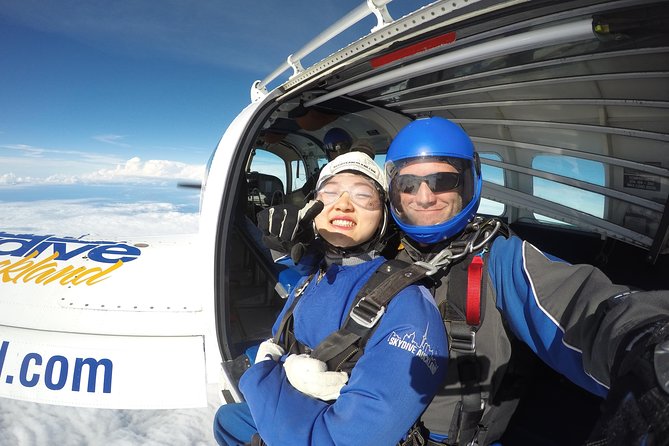
The view list is unusually broad for an Auckland tandem jump. Looking toward the east, you may see Waiheke Island and Great Barrier Island. Looking west, Piha Beach and the west coast can come into view. The exact sightline depends on the flight path and weather.
The mention of both coasts is especially useful. Auckland is shaped by its position between two very different shorelines, and seeing that geography from the air gives you a fresh sense of the region. You may also see rain forests and beaches below, rather than only built-up suburbs.
Mount Ruapehu and Mount Taranaki are listed among possible distant sights. These are not guaranteed. Haze, cloud, and the aircraft’s route will decide how much of the far horizon you can see. Still, the possibility adds another layer to the flight, especially for visitors who want a broad view of New Zealand rather than a close look at Auckland alone.
The best practical tip is to choose a day with good visibility if your schedule allows it. Weather is already a safety factor, but visibility affects the sightseeing value too. A jump can go ahead in conditions that are safe yet less rewarding for distant views.
A social aircraft, but not a small private outing
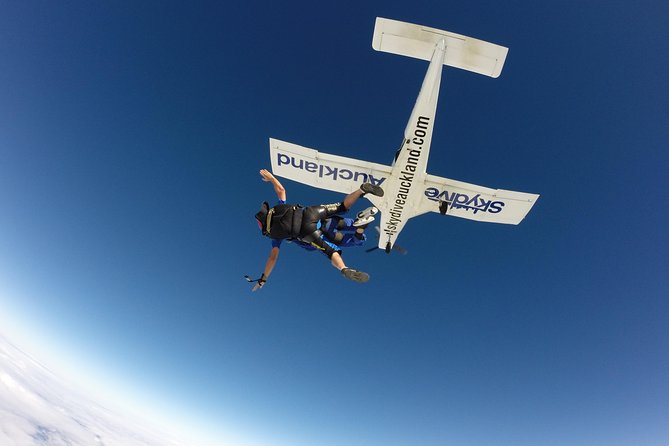
The 17-seat turbine aircraft is a useful feature for friends or family groups. You can travel to the airport together and share the build-up before your turns. For many people, that shared anticipation is part of the fun.
The full activity can accommodate up to 100 people, so this is not a tiny, private experience. You should expect other participants at the airport and in the wider operation. That can create energy and support, but it may also mean some waiting around.
The three-hour estimate gives you a realistic planning window, though the exact pace may depend on the number of people booked and the weather. I would keep the rest of your day flexible. A jump is exciting, and you may want time afterward to settle down, watch your photos, or simply talk through what happened.
The real price of the experience
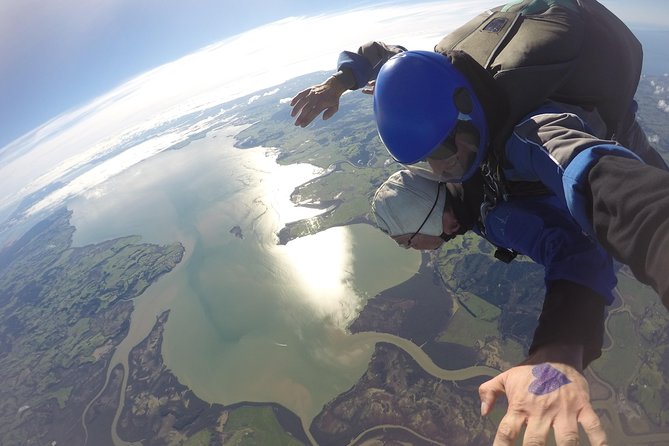
At $214.10 per person, the value depends on what you want from the day. You are paying for a tandem jump, the equipment, a full safety briefing, the aircraft ride, and a major view over the Auckland region. That is a reasonable way to judge the price, rather than comparing it with the cost of an ordinary scenic flight.
The altitude matters most. A 9,000-foot jump and a top-altitude jump do not offer the same length of freefall, so confirm which option the price covers. Photo and video packages are not included. If you want a record of the jump, set aside extra money and ask for the current media prices before you arrive.
I see the strongest value for a first-time jumper who wants one memorable New Zealand activity and does not mind spending half a day on it. The setting, long freefall option, and views give it more substance than a short amusement-park thrill.
The price is less compelling if your group only wants a scenic view or if you are uncertain about the jump itself. In that case, think carefully before paying for the highest package. The lower option may be a sensible compromise, but you still need to be ready for the tandem experience.
Weather can change the whole plan
Weather is the main practical weakness. You need to contact the operator one hour before your booking to confirm that conditions are suitable. If poor weather forces a cancellation, you can choose another date or receive a full refund.
That policy is fair, but the disruption can still be inconvenient if you have a packed Auckland schedule. I recommend booking this early in your visit, not on your final day, if you have any flexibility. The experience is booked an average of 31 days ahead, so reserve before your trip if the timing matters.
You can cancel for a full refund if you do so at least 24 hours before the start time. Cancellations or changes made less than 24 hours before the activity are not accepted for a refund. Weather cancellations are handled differently, with a new date or full refund offered.
Who should book Skydive Auckland?
I would recommend it to you if you want a major adrenaline activity, enjoy dramatic views, and can spare about three hours plus transport time. It suits first-time jumpers as well as people who want a higher-altitude tandem experience, since the instructor handles the technical side.
It can also work well for a parent and older teenager. Children under 18 need a parent or guardian present, and the 18,000-foot option is limited to ages 12 and above. The 100-kilogram limit is important for planning.
I would hesitate if you dislike uncertainty, need a guaranteed schedule, or mainly want a calm aerial tour. Weather may move your booking, the wider operation can include many people, and the freefall is an intense physical experience. You should also be comfortable paying extra if you want photos or video.
Should you book this Auckland skydive?
Book it if you want to combine New Zealand scenery with a genuine challenge. The strongest reasons are the choice of altitudes, the chance of a long freefall, and the view across islands, beaches, both coasts, and distant mountains. The company’s long operating history and safety credentials add confidence, while names such as Owen suggest a personal staff experience may be part of the day.
Before paying, confirm the exact jump height included, the current cost of each package, transport details, and photo or video prices. Then choose a day with some schedule flexibility. If you can accept those conditions, Skydive Auckland offers a memorable way to see the region from well above the ground.
FAQ
Where does Skydive Auckland operate?
The meeting point is West Auckland Airport at 76 Green Road, Parakai, Helensville, New Zealand. The activity ends back at the same meeting point.
How far is Parakai from Auckland city?
Parakai is about a 45-minute drive from Auckland city. Round-trip hotel transport to the launch point is available.
How long does the activity take?
The full experience takes approximately three hours.
What jump heights are available?
Options are listed at 9,000 feet, 13,000 feet, 18,000 feet, and up to 20,000 feet. Confirm the exact height and price when booking.
How long is the freefall?
The 18,000-foot description gives a freefall of about 75 seconds. The highest advertised option provides more than one minute of freefall.
What views might I see?
Possible views include the east and west coasts, Waiheke Island, Great Barrier Island, Piha Beach, rain forests, Mount Ruapehu, and Mount Taranaki.
What should I wear?
Wear comfortable clothing and secure shoes, such as trainers or sneakers. All skydiving equipment is provided.
Is there a weight limit?
Yes. The weight restriction is 100 kilograms.
Can someone under 18 participate?
Yes, but anyone under 18 must bring a parent or guardian. The 18,000-foot option is limited to people aged 12 and over.
Are photos and videos included?
No. Photo and video packages are available to purchase on the day.
What happens if the weather is poor?
You should contact the operator one hour before your booking to confirm conditions. If poor weather cancels the activity, you can reschedule or receive a full refund.
Can I cancel for a refund?
You can cancel at least 24 hours before the start time for a full refund. Cancellations or changes made less than 24 hours before the start time are not accepted for a refund.
Just added in Auckland
- Auckland: Half-Day Sea Kayak Tour to Motukorea Island★ 5.0 · 6 reviews
- Auckland Food Walking Tour★ 5.0 · 73 reviews
- Auckland: Segway to North Head Volcano Summit★ 4.9 · 53 reviews
- Day sea kayak tour Rangitoto Island★ 5.0 · 79 reviews
- The Tastebud Tour, award winning food tour of Auckland★ 5.0 · 124 reviews
- Auckland: Rotorua Wai-O-Tapu, Te Puia with Haka★ 4.9 · 161 reviews
- Sunset kayak tour to Rangitoto Island★ 5.0 · 168 reviews
- Hobbiton Movie Set Tour with lunch from Auckland★ 5.0 · 168 reviews
Skydiving & Bungy, compared.
15,000ft Tandem Skydive in Tauranga – Bay of Plenty
Read our review →

Browse the lists this tour appears in